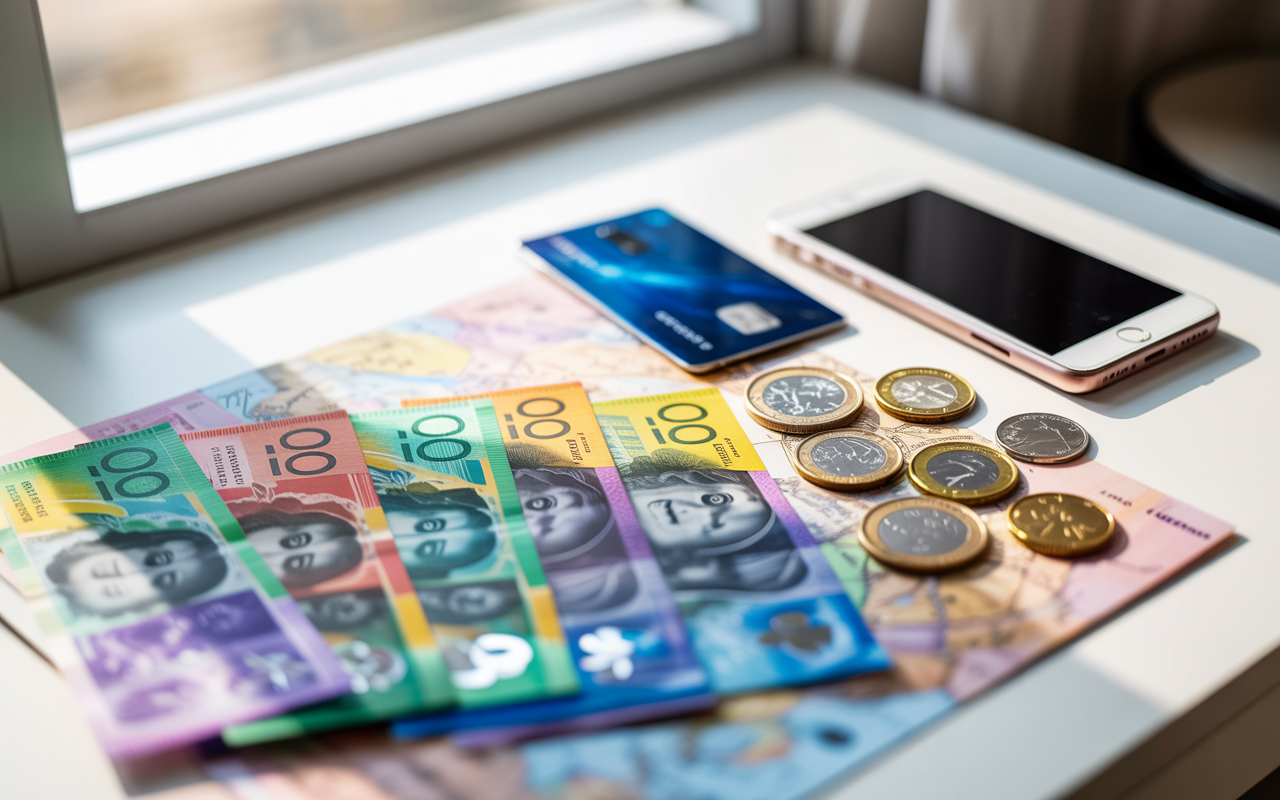
That little 'pay in AUD or your own currency?' prompt on card machines, ATMs and websites can quietly cost you 3-8% every single time. Here's the honest answer on which to choose — and how to keep more of your money for the fun stuff.
In This Guide
- 1. The Short Answer: Always Pay in AUD
- 2. What Is Dynamic Currency Conversion (DCC)?
- 3. How Much Does DCC Actually Cost?
- 4. Card Payments: Always Tap in AUD
- 5. ATM Withdrawals: Withdraw in AUD, Decline the Conversion
- 6. Booking Tours & Activities Online
- 7. Avoid Foreign Transaction Fees Too
- 8. Quick Checklist Before You Tap
The Short Answer: Always Pay in AUD
Whenever a card machine, ATM, or website asks whether you'd like to pay in Australian dollars (AUD) or your home currency (GBP, EUR, USD, and so on), choose Australian dollars every time.
It feels reassuring to see the price in your own currency — you know exactly what you're spending. But that convenience is exactly how the fee is hidden. Paying in your home currency triggers something called Dynamic Currency Conversion, and the exchange rate used is almost always worse than the one your own bank would give you. Over a few weeks of travel, that adds up to real money.
What Is Dynamic Currency Conversion (DCC)?
Dynamic Currency Conversion is when an Australian merchant, ATM or website converts the price into your home currency *at the point of sale*, instead of letting your own bank do it.
On the surface it sounds helpful. In practice, the merchant (or the payment company behind the terminal) gets to set the exchange rate — and they build in a markup, typically 3-8% on top of the real rate. That markup is shared between the terminal provider and the merchant; none of it benefits you.
When you pay in AUD instead, the conversion is handled by Visa or Mastercard using their wholesale exchange rate, which is very close to the 'real' mid-market rate you'd see on Google. That's almost always the cheaper path.
How Much Does DCC Actually Cost?
Let's put rough numbers on it. Say you book a A$500 sailing trip and the website offers to charge you in your home currency instead.
• Pay in AUD: Visa/Mastercard convert at roughly the mid-market rate. You pay close to the true A$500 value in your currency. • Pay in your home currency (DCC): A 3-8% markup is baked into the rate — so that same A$500 might cost you the equivalent of A$515 to A$540.
That's A$15-40 gone on a single booking, for nothing. Do that across tours, hostels, restaurants and ATM withdrawals over a multi-week trip and it easily becomes a few hundred dollars — enough for another day trip or a couple of nights' accommodation.
(These figures are illustrative; the exact markup depends on the terminal and provider — but the direction is always the same: DCC costs you more.)
Card Payments: Always Tap in AUD
When you tap or insert your card at a shop, cafe, tour desk or restaurant, the terminal may show two buttons — one with the price in AUD and one in your home currency.
• Always choose the AUD option. • If the staff member selects your home currency for you (some terminals default to it), politely ask them to run it in Australian dollars. • The same applies to contactless and mobile wallet payments (Apple Pay / Google Pay) — the DCC prompt can still appear.
You are always allowed to pay in AUD. Merchants must give you the choice — don't be talked out of it.
ATM Withdrawals: Withdraw in AUD, Decline the Conversion
Australian ATMs are one of the most common places DCC catches travellers out. After you enter your amount, the screen often says something like: 'Would you like to proceed with conversion?' and shows a guaranteed rate in your home currency.
• Choose 'Decline conversion' or 'Continue without conversion' — this lets your own bank convert at its (better) rate. • Use bank-operated ATMs (Commonwealth Bank, Westpac, ANZ, NAB) rather than the standalone machines in pubs and convenience stores, which often add their own extra fees on top. • Withdraw larger amounts less often to minimise fixed per-withdrawal fees — but only carry what you're comfortable with.
Booking Tours & Activities Online
The same rule applies online. Some international booking platforms will detect your location and offer to charge you in your home currency 'for convenience' — again at a marked-up rate.
When you book your tours and experiences directly with us, you're charged in Australian dollars, so the conversion is handled by your own bank or travel card at the fair rate — no sneaky DCC markup. Booking direct also means the price you see is the price that reaches the operator, with no third-party currency margin skimmed off in between.
Avoid Foreign Transaction Fees Too
DCC is separate from your own bank's foreign transaction fee — and both can bite. Many home-country debit and credit cards charge around 2-3% on every overseas purchase, on top of anything DCC would add.
The fix is a fee-free travel card: • Wise, Revolut, Monzo, Starling (and similar) let you hold or spend AUD with little to no foreign transaction fee and near mid-market exchange rates. • Load or convert to AUD before you travel, or let the card auto-convert at the point of sale. • Always still choose AUD at the terminal — a good travel card plus paying in local currency is the cheapest combination.
Check your existing bank's overseas fees before you fly; if they're high, a travel card can pay for itself in the first week.
Quick Checklist Before You Tap
• Card machine asks AUD or home currency? → Choose AUD. • ATM offers a 'guaranteed' home-currency rate? → Decline conversion. • Website offers to charge in your currency? → Switch it to AUD. • Booking a tour? → Book direct and pay in AUD. • Worried about your bank's fees? → Get a fee-free travel card (Wise, Revolut, etc.).
Follow those five and you'll consistently get the fairest exchange rate — leaving more in the budget for the reef, the islands and the road trip.
Ready to Start Your Adventure?
Our local team in Noosa can help you plan the perfect trip with best price guarantee.